

Ask any small transport owner what keeps them up at night, and diesel will come up within the first two minutes. It’s the biggest cost you have after the vehicle itself, and you have zero control over it. Prices go up, your freight rates don’t, and the difference comes straight out of your margin.
That’s why more and more operators are asking a simple question: if I switch to electric, how much will I actually save?
Let’s work it out properly, with real numbers, not brochure promises.
The fuel bill: where most of the money is
Take a typical small business running a 1-tonne mini truck about 100 km a day, 26 days a month. That’s roughly 2,600 km every month.
On diesel: A loaded mini truck in city traffic gives you somewhere around 14 to 16 km per litre on a good day. Let’s be generous and say 15. That’s about 173 litres a month. At around ₹95 a litre (roughly what Delhi pays right now), you’re spending close to ₹16,500 a month on fuel alone. That works out to about ₹6.30 for every kilometre.
On electric: An electric mini truck uses roughly 0.1 to 0.12 units of electricity per kilometre. If you charge mostly at your shop or godown at about ₹9 a unit, you’re paying around ₹1 to ₹1.10 per km. Even if you top up at a public fast charger now and then, which costs more, your monthly bill sits somewhere around ₹2,800 to ₹3,200.
That’s a difference of roughly ₹13,000 a month, just on fuel. Over a year, it’s well over ₹1.5 lakh.
Your numbers will differ. Your route, your load, your electricity tariff all play a part. But the gap is big enough that even with cautious assumptions, it doesn’t disappear.
Maintenance: the savings nobody talks about
Fuel gets all the attention, but maintenance is where EVs quietly win too.
A diesel engine has hundreds of moving parts. Engine oil, oil filter, fuel filter, air filter, clutch plates, injectors, the exhaust system. Every one of these needs regular attention, and some of them fail at the worst possible time.
An electric motor has very few moving parts. No oil changes, no clutch, no fuel system. Brakes also last longer because regenerative braking does part of the slowing down. Most operators find their routine servicing cost drops to a fraction of what it was.
Conservatively, that’s another ₹1,000 to ₹1,500 a month saved, plus fewer days off the road. And a truck that isn’t sitting in the workshop is a truck that’s earning.
But the EV costs more upfront. Doesn’t that cancel it out?
This is the fair question, and it deserves a straight answer.
Yes, an electric cargo vehicle usually costs more to buy than a comparable diesel one. But look at it like this: if you’re saving ₹14,000 to ₹15,000 a month on fuel and maintenance, a price gap of ₹1.5 lakh gets paid back in about a year. After that, every rupee saved is profit.
Most commercial vehicles stay with their owners for five years or more. Do the math over that period and the EV comes out far ahead.
If you’d like to see this for your own business, the TCO calculator on Euler Motors’ website lets you plug in your daily distance and ownership period and compare directly against diesel, petrol or CNG. It takes about a minute.
A quick look at the yearly picture
For our 100 km/day example:
|
|
Diesel |
Electric |
|---|---|---|
|
Fuel/charging per month |
~₹16,500 |
~₹3,000 |
|
Maintenance per month |
~₹2,000 |
~₹600 |
|
Running cost per year |
~₹2.2 lakh |
~₹43,000 |
That’s a difference of around ₹1.75 lakh a year in running costs alone.
What can shrink your savings
Let’s be honest about the other side too. Savings can drop if:
-
You rely mostly on public fast chargers, which cost more per unit than home charging
-
Your daily running is very low, say 30 to 40 km, which means fuel costs were never that high to begin with
-
You don’t have a place to charge overnight
None of these are deal-breakers, but they’re worth thinking through before you buy.
What can grow your savings
On the flip side, savings get bigger if:
-
You run more than 100 km a day, or double shifts
-
Your area has a low commercial electricity tariff
-
You get state EV subsidies, road tax waivers or registration benefits, which many states offer
So, is it worth it?
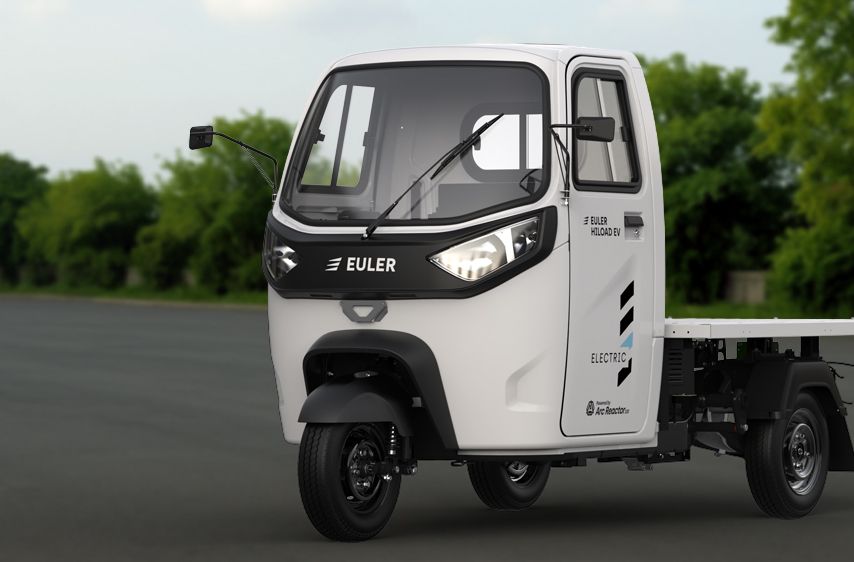
For most small businesses running daily city or suburban routes, the answer is yes, and not by a small margin. A 1-tonne electric truck like the Euler Turbo EV 1000 is built for exactly this kind of work: daily loads, city traffic and tight margins.
The best way to be sure is to see one in person. Visit your nearest Euler Motors dealership, take a test drive with a real load, and ask them to run the numbers for your route. Once you see what you’re spending on diesel every month in black and white, the decision usually makes itself.
